01
Platform Requirements
Identify the features your business needs now and those it may require in the future. Consider product management, checkout functionality, customer accounts, integrations and custom workflows.
PrestaShop Migration
Your eCommerce platform should support your business as it grows. But as your product catalogue expands, customer expectations change and operations become more complex, your existing PrestaShop store may no longer meet your requirements.
If managing your store is becoming difficult, it may be time to explore other options. We help businesses evaluate their eCommerce requirements and build online store solutions that align with their operational needs and future growth goals.
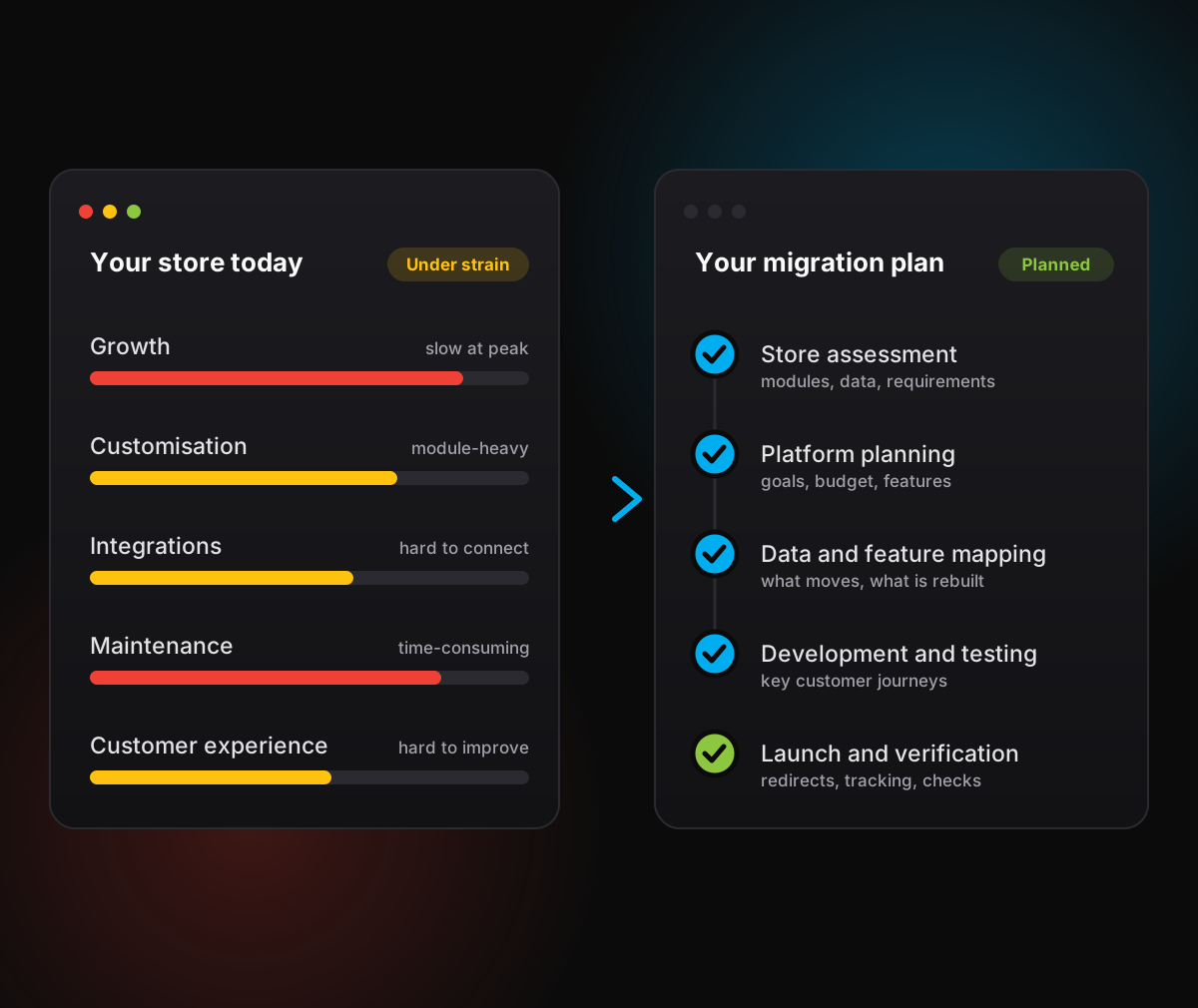
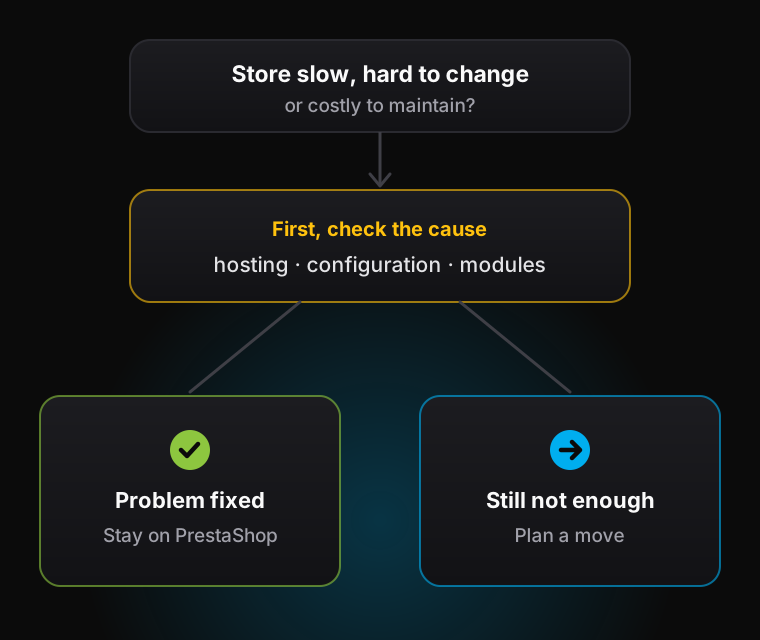
The short answer: consider moving from PrestaShop when growth, customisation, integrations or maintenance keep holding your business back after you have already reviewed your hosting, configuration and modules. If those fixes work, staying put is often the better decision.
PrestaShop offers businesses a flexible foundation for building and managing online stores. However, the right platform depends on how your business operates, the features you need and the level of flexibility you expect.
As your business grows, your eCommerce needs change. You might need better integrations, faster website performance, easier store management, or more flexibility to customise your store. Moving away from PrestaShop should not be based on trends alone. It should come from understanding whether your current platform can continue supporting your business effectively.
PrestaShop limitations
As your product catalogue, customer base and order volume increase, your store may require additional infrastructure and performance improvements. Scalability is one of the first things to check. If your website experiences slow loading, inconsistent performance or difficulties during high-traffic periods, review whether the issue comes from hosting, configuration, modules or the platform itself. If ongoing improvements still do not meet your business requirements, it may be worth exploring other eCommerce platforms.
Your business may require features that go beyond standard eCommerce functionality. When custom features depend on multiple modules, complicated modifications or extensive development work, managing future changes can become challenging. A different platform or a custom-built solution may provide a better fit for your specific business requirements.
As your business grows, your online store may need to connect with different tools, such as CRM systems, ERP software, payment providers, inventory tools and shipping services. If connecting and managing these tools becomes difficult or creates challenges in your daily operations, it may be time to consider other options.
Regular updates, module compatibility, security checks and technical troubleshooting are important parts of managing an eCommerce store. If maintenance is taking time away from product development, customer service and business operations, consider whether your current setup is sustainable. A platform with a more suitable maintenance model may help simplify ongoing store management.
Your customers may expect faster checkout experiences, improved mobile shopping, personalised product recommendations or more flexible buying journeys. If your current store architecture makes these improvements difficult or expensive to implement, evaluating alternative solutions may be the right next step. The goal is not simply to adopt newer technology. It is to create an experience that supports your customers and business objectives.
Before you decide
Moving to another eCommerce platform is a significant business decision. Before starting, evaluate these important factors.
01
Identify the features your business needs now and those it may require in the future. Consider product management, checkout functionality, customer accounts, integrations and custom workflows.
02
Compare more than the initial migration cost. Include platform subscriptions, hosting, development, maintenance, third-party applications and future customisation.
03
Plan how products, customer information, order history, categories and other essential store data will be transferred. Not every platform supports the same data structures, so some information may need transformation or manual reconstruction.
04
Your existing store may already have valuable search visibility. Review current URLs, metadata, indexed pages, backlinks and internal links before migration. Prepare URL redirects and check canonical tags, sitemaps and indexing after launch.
05
Confirm that the new platform can support your existing payment gateways, shipping providers, inventory systems and business applications.
PrestaShop migration
A successful migration requires more than transferring products from one platform to another. It involves understanding your existing store and planning how its essential components will work in the new environment. Our CMS migration services cover PrestaShop stores. A typical project includes:
Review your existing PrestaShop setup, functionality, modules, data and technical requirements.
Evaluate suitable platforms based on your business objectives, budget and required functionality.
Identify the information, integrations and features that need to be transferred, rebuilt or improved.
Build the new store, configure integrations and test essential customer journeys.
Complete the migration, check redirects and tracking, and verify that important store functions work correctly.
Consider migration when your store consistently struggles to meet your business requirements, particularly around custom functionality, integrations, maintenance or scalability. First determine whether these problems can be resolved within your existing setup.
PrestaShop can support growing businesses, depending on hosting, configuration, modules and development requirements. Growth alone is not a reason to migrate. Evaluate your store’s actual performance and operational needs before making a decision.
Common alternatives include Shopify, WooCommerce and Adobe Commerce. Each has different pricing models, customisation options, infrastructure requirements and management responsibilities. The right choice depends on your business needs. For B2B stores, OroCommerce is another platform we build on.
Product information, customer records and order history can generally be migrated, depending on the source data and destination platform. However, data structures, formats and import capabilities may differ between platforms. Some information may require data transformation, custom mapping or additional development to ensure a smooth migration.
Migration can affect organic search visibility if URLs, metadata, redirects or important content are not handled correctly. A migration plan should include URL mapping, relevant redirects, canonical checks and post-launch monitoring.
The timeline depends on store size, data volume, custom functionality, integrations and the destination platform. A smaller store may require less work than a complex store with extensive custom features. A technical assessment is needed for a realistic estimate.



PrestaShop Migration
Not sure whether your current store can support your next stage of growth? Talk to our team about your eCommerce requirements and possible solutions.