Safari Booking Systems: How Kenyan Tour Operators Automate Enquiries, Quotes and Bookings
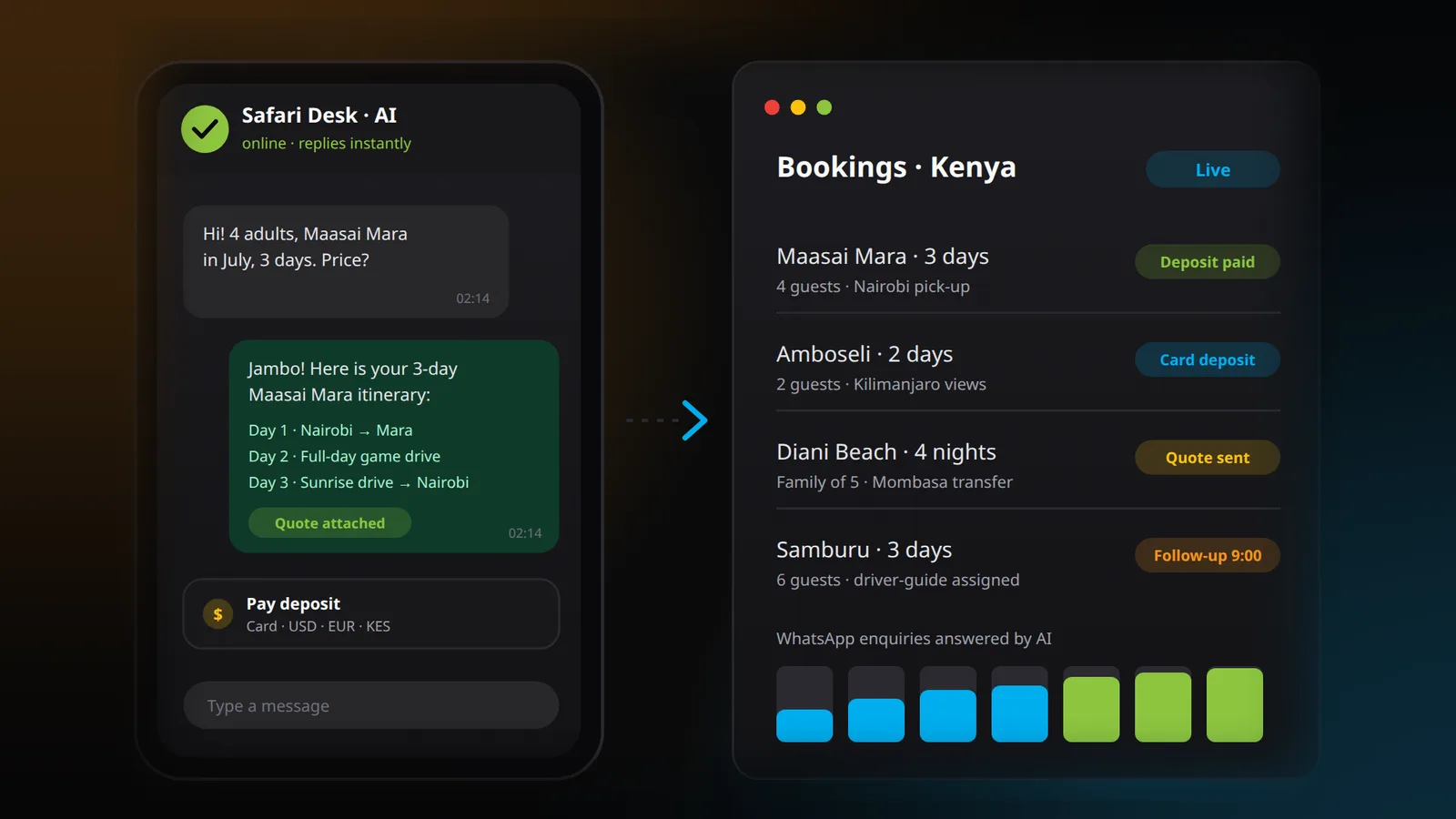
A guest in Germany asks for a four-day Maasai Mara and Lake Nakuru trip at 2 a.m. Nairobi time. They have sent the same message to five other operators. The operator who replies first with a clear itinerary, a price and an easy way to pay a deposit usually wins the booking. A safari booking system, with AI handling the first reply and the draft quote, is how a small Kenyan operator does that every time without staff working through the night.
This guide explains what a safari booking system does, the features that matter for Kenyan operators, where AI helps and where it should not decide alone, how to take payments in several currencies, and how to move off spreadsheets step by step.
What is a safari booking system?
A safari booking system is software that lets a tour operator sell and manage trips in one place. It holds your packages, vehicles, driver-guides and lodge allocations, shows live availability, applies the right seasonal rates, takes deposits and balances, sends confirmations and reminders, and reports on bookings and revenue. Most include a booking widget for your own website, so guests can book and pay directly.
For many operators it replaces a mix of spreadsheets, email threads, WhatsApp chats on staff phones and a whiteboard for vehicle allocation.
Why safari bookings are hard to run by hand
- Guests are in other time zones. Enquiries from Europe, North America and Asia arrive while your office is closed, and guests compare several operators at once.
- Every quote is a calculation. Lodge or camp rates, park and conservancy fees, vehicle and fuel costs, flights, group size and children all change the price.
- Rates change by season. High, low and green season prices, and lodge rates that are updated each year.
- Resources are limited. You have a fixed number of vehicles, guides and lodge rooms on allocation, and a double booking is expensive to fix in the bush.
- Payments are spread out. Deposits at booking, balances before travel, different currencies, and suppliers to pay.
- Leads get lost. When enquiries live in personal inboxes and phones, follow-ups depend on someone remembering.
Features to look for in a safari booking system
- Package and itinerary builder for fixed departures and tailor-made trips, with day-by-day plans for routes such as Nairobi, Maasai Mara, Lake Nakuru, Amboseli, Tsavo and the coast.
- Seasonal and resident pricing, including high, low and green season rates and separate rates where you offer them to East African residents.
- Live availability for vehicles, driver-guides and lodge or camp rooms, so a seat sold on your website cannot be sold again elsewhere.
- Deposits and balances with automatic reminders before the balance is due.
- Multi-currency payments in USD, EUR, GBP and KES, matched to each booking.
- Allocation calendar to assign vehicles and guides, and trip sheets sent to drivers’ phones.
- Guest communication by email and WhatsApp: confirmations, packing lists, pre-arrival details and post-trip reviews.
- Channel sync with the marketplaces and OTAs you list on, so availability stays correct everywhere.
- Reports on enquiries, conversion, revenue by package and season, and channel performance.
Where AI helps: enquiries and itinerary quotes
The two slowest steps for most operators are the first reply and the quote. This is where AI earns its place.
- Instant WhatsApp and web replies. An AI assistant answers every enquiry immediately in the guest’s time zone, asks for travel dates, group size, budget and interests, and saves the answers on the lead. Read more about how this works in our guide to a WhatsApp CRM in Kenya.
- Draft itineraries and quotes. From your own rate sheets, lodge rates and park fees, AI can draft a day-by-day itinerary and a priced quote in seconds.
- Follow-ups. Guests who received a quote and went quiet get a polite reminder, and your team sees who is ready to book.
Keep a person in charge of the final price and of anything unusual. A member of your team should review every quote before it goes out, particularly for peak dates, large groups, custom routes and special requests. Park and conservancy fees change, so keep them in one place the system reads from rather than in old quote templates.
Taking payments: deposits, balances and multiple currencies
Most international guests pay their deposit by card, so your booking system needs a secure card payment gateway that settles in the currencies you price in, such as USD, EUR, GBP and KES.
Take the deposit at booking, send automatic reminders before the balance is due, and set clear refund rules for cancellations. Every payment is then matched to its trip, so your team is not reconciling bank statements and payment emails by hand.
Manual safari bookings vs an automated booking system
| Run by hand | With a safari booking system | |
|---|---|---|
| First reply | When the office opens | Instant, day or night |
| Quotes | Typed from spreadsheets | Drafted from your rates, reviewed by your team |
| Availability | Checked by phone and email | Live for vehicles, guides and rooms |
| Deposits | Chased one by one | Payment links with automatic reminders |
| Allocation | Whiteboard or spreadsheet | One calendar and trip sheets on drivers’ phones |
| Leads | Spread across staff inboxes and phones | One pipeline for the whole team |
Direct bookings vs marketplaces and OTAs
Safari marketplaces and OTAs bring guests who are still comparing operators, and many Kenyan operators get a large share of their enquiries there. They usually charge commission or listing fees. A booking engine on your own website lets returning guests, referrals and people who find you on Google book and pay directly. The two work together: keep the listings that bring you good guests, sync availability from one system so you never oversell, and make your own website the easiest place to book.
Your website also needs to be found. Structured itinerary and destination pages help Google and AI assistants recommend your Maasai Mara, Amboseli or Samburu trips by name.
How to move from spreadsheets to a booking system
- Map how you sell today, from the first enquiry to the post-trip review, and note where time is lost.
- Collect your rates in one place: packages, lodge rates, park fees, vehicle costs and seasons.
- Start with your best-selling packages and your deposit process, not every trip you have ever run.
- Connect payments: a card gateway for international guests, in the currencies you sell in.
- Add AI replies and quotes once your rates are clean, with your team reviewing every quote at first.
- Connect your channels and your accounting tools, then train your team and go live before the next high season.
BookB: a booking engine shaped around your safari business
BookB is the booking engine built by Techrish. It handles online reservations through a branded widget on your website, real-time availability across every channel, deposits, full payments and refunds through secure payment gateways, automatic confirmations and reminders by email, SMS and WhatsApp, and reports on bookings, revenue and channel performance. For tour operators, it manages group sizes, collects participant details, takes deposits and sends itineraries as each booking comes in.
Every BookB deployment is configured around your packages, pricing rules and policies. For Kenyan safari operators, Techrish adds what the market needs: multi-currency pricing, vehicle, guide and lodge allocation, an AI WhatsApp assistant powered by Trixloop for enquiries, and an AI itinerary and quote builder that your team reviews before sending. See the full range of what we build for Kenyan businesses on our AI development company in Kenya page.



 WhatsApp