

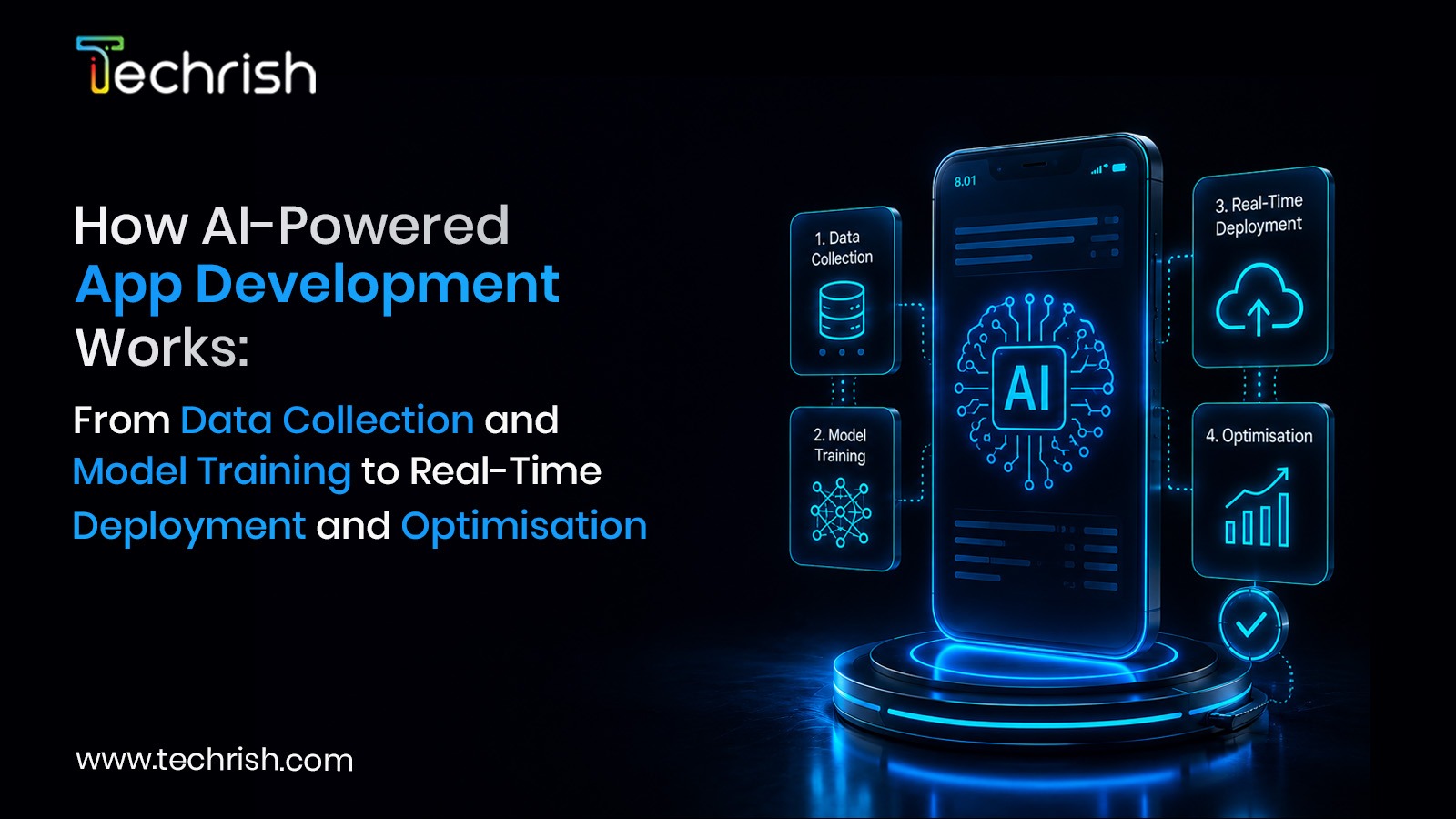
Have you ever wondered how Google Maps predicts traffic in real time, how Netflix always seems to know exactly what you want to watch next, or how your email automatically sends spam straight to the junk folder? Behind all of these experiences is one powerful approach: AI-powered app development.
Whether you are a business owner considering working with an AI-powered app development company, a startup exploring custom app ideas, or simply someone curious about technology, this guide breaks the whole process down step by step, in plain English that anyone can follow.
What Is an AI-Powered App?
An AI-powered app is software that uses artificial intelligence to handle tasks that would normally require human thinking, things like understanding language, recognising images, predicting what you might need, or making smart personalised suggestions.
Unlike traditional apps that follow a fixed set of rules (“if this happens, do that”), AI apps learn from experience. The more data they are exposed to, the smarter and more accurate they become over time.
You see this in action every day: a custom booking app development solution that learns your scheduling preferences, a streaming app that refines its recommendations based on your viewing habits, or a customer service chatbot that improves the more it interacts with users.
Stage 1: Data Collection — Feeding the Machine
Every AI app begins with data. Data is simply information; it could be text, images, numbers, clicks, purchases, reviews, or any kind of digital record.
Think of it like teaching a young child. Before a child can recognise a cat, they need to see hundreds of cats in different settings, colours, and sizes. AI works in the same way. The more examples it sees, the more confident and accurate its understanding becomes.
Where does data come from?
- User behaviour on websites and apps — what people search for, click, buy, or skip
- Public datasets — such as Wikipedia, open government records, or medical databases
- Smart devices and sensors — fitness trackers, weather stations, connected home devices
- Business records — customer orders, support tickets, transaction histories
- Custom inputs — for example, bookings and preferences fed into a custom booking app development system
One important principle every good mobile app development company stands behind: the quality of data collected at this stage shapes everything that follows. Poor data leads to poor AI. Good data leads to a product that genuinely helps people.
Stage 2: Data Preparation — Making It Usable
Raw data is almost never clean. It arrives with typos, duplicates, missing values, and irrelevant entries. Before an AI model can learn from it, the data must be carefully cleaned and organised. This is called data preparation or data preprocessing.
What does data preparation involve?
- Cleaning — Removing errors, duplicate records, and entries that do not belong
- Labelling — Tagging data so the AI understands what it represents (for example, marking photos as “cat” or “not a cat”)
- Structuring — Organising data into a format the AI can process efficiently
- Splitting — Dividing data into a training set (to learn from) and a test set (to measure how well it has learned)
Data preparation is one of the most time-consuming stages of AI development, but it is also one of the most critical. Skipping or rushing this step is a common reason AI projects fail. Any experienced AI-powered app development company will invest significant time here before a single line of model code is written.
Stage 3: Model Training — Teaching the AI
This is often described as where the magic happens. The model is the brain of the AI app, a mathematical system that learns to recognise patterns from the data it is shown.
During training, the model processes thousands or even millions of examples. Each time it makes a guess, it checks whether that guess was right or wrong, and then adjusts itself to do better next time. This cycle repeats continuously until the model reaches a level of accuracy that makes it genuinely useful.
How does training work in simple terms?
- The model looks at a data example and makes a prediction
- It checks whether the prediction was correct
- It adjusts itself slightly to improve accuracy
- This process repeats millions of times across the entire dataset
Popular tools used during this stage include TensorFlow, PyTorch, and cloud-based AI platforms from Google, Amazon, and Microsoft. The more high-quality data and computing power available, the more powerful and accurate the trained model becomes.
Stage 4: Testing and Validation — Checking the Work
Before any AI app is made available to real users, it must be put through rigorous testing. This stage answers a fundamental question: does the model actually work well in the real world?
What gets tested?
- Accuracy — How often does it produce the right result?
- Fairness — Is it unintentionally biased against any group of users?
- Edge cases — What happens when the input is unusual, incomplete, or unexpected?
- Speed — Can it respond fast enough to feel natural during real use?
If the model does not meet the required standards, the team goes back to adjust the data, the model architecture, or both and trains again. This loop repeats until performance is consistently reliable. No reputable mobile app development company will skip this step, regardless of how promising the initial results look.
Stage 5: Real-Time Deployment — Going Live
Once the model clears testing, it is deployed, connected to the actual app and made available to real users.
At this point, the trained AI model is integrated into a live system that can:
- Receive real-world inputs such as a user typing a search query or completing a booking form
- Process those inputs instantly using the AI model
- Return a useful, accurate response within milliseconds
Modern AI apps are typically hosted on major cloud platforms like AWS, Google Cloud, or Microsoft Azure. This allows them to serve thousands or millions of users at the same time without slowing down. APIs (Application Programming Interfaces) act as the bridges that connect the AI model to the rest of the app, allowing every part of the system to communicate smoothly.
For example, a custom booking app development platform uses this architecture to process appointment requests, check availability, confirm bookings, and send notifications, all powered by AI, all happening in real time.
Stage 6: Monitoring and Continuous Optimisation — Staying Smart
Deployment is not the finish line. It is actually the start of a new and equally important phase.
Once real users begin interacting with the app, new data is generated constantly. The world changes, user behaviour evolves, and even a well-trained model can become less accurate over time if it is not updated. This gradual decline in performance is called model drift, and managing it is essential.
What happens during this stage?
- Performance monitoring — Teams track accuracy, response speed, and errors in real time
- User feedback loops — How users behave tells the system what is working and what needs to improve
- Retraining — The model is regularly updated with fresh data to stay relevant and accurate
- A/B testing — Different versions of the model are compared to identify which performs best
This stage never truly ends. The best AI applications, whether built by an independent developer or a full-scale AI-powered app development company, are those that keep learning, adapting, and improving long after their initial launch.
The Full Picture: A Continuous Cycle, Not a Straight Line
The most important thing to understand about AI-powered app development is that it is not a one-time process. It is a living, ongoing cycle:
Data → Preparation → Training → Testing → Deployment → Monitoring → (New Data) → Training Again
Every time the app runs in the real world, it generates new data. That data feeds back into the system, helping the AI become smarter with each cycle. This is what separates a good AI app from a truly great one.
Why This Matters for Businesses and Users
Understanding how AI-powered apps are built helps businesses make smarter decisions:
- Investment planning: AI development takes time and resources; knowing the stages helps set realistic budgets and timelines
- Expectations: The best results come over time, not overnight; models improve with use
- Choosing partners: Whether you need a mobile app development company for a consumer product or an AI-powered app development company for an enterprise solution, understanding the process helps you ask the right questions
- Building the right product: If you are considering custom booking app development, knowing how AI learns from user behaviour helps you design a smarter, more personalised experience from the start
For users, a well-built AI app means better recommendations, fewer errors, faster service, and experiences that feel personal rather than generic.
Conclusion
AI-powered app development is a careful, structured journey from raw data to a smart, continuously improving product. Each stage collecting data, preparing it, training the model, testing it, deploying it, and optimising it over time plays an essential role in delivering an experience that feels effortless to the end user.
The apps we rely on every day did not become smart overnight. They were trained, tested, refined, and taught just like a skilled professional who keeps getting better with experience.
Whether you are exploring a new app idea, looking for the right mobile app development company to bring it to life, or planning a custom booking app development project powered by AI, understanding this process will help you build something that genuinely makes a difference.