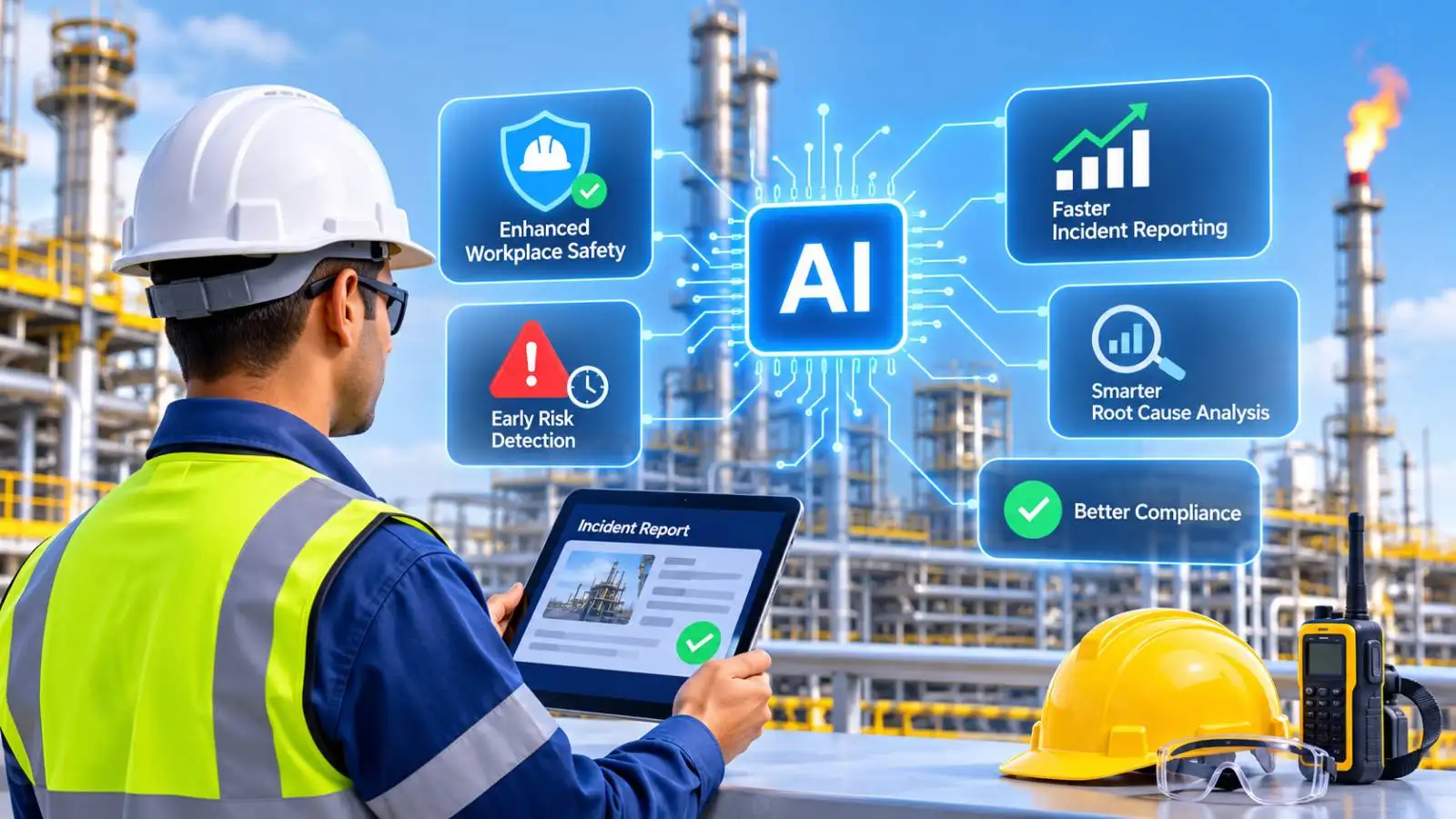
How AI Helps Oil and Gas HSE and Incident Reporting
AI can make HSE (health, safety and environment) reporting in oil and gas faster, more complete and easier to act on. It helps people capture incidents and near misses quickly, turns free-text reports into structured records, spots repeat problems across sites and chases the corrective actions that follow. It does not replace HSE officers or investigations: people stay in charge of every safety decision.
This guide explains where AI fits in HSE and incident reporting, what it should never do, and how an oil and gas business in Kuwait or the Gulf can start with one report type and measure the result.
Why is incident reporting hard in oil and gas?
Incident reporting is hard because the people who see an event are busy, the report is often written after the shift, and the details end up spread across paper forms, spreadsheets, emails and several systems. The usual problems are:
- Late or missing reports. Near misses in particular go unreported when the form is long or awkward to fill in on site.
- Inconsistent detail. Free-text descriptions vary in quality, and the same type of event gets different labels depending on who writes it.
- Scattered records. Permits, inspection checklists, investigation notes and corrective actions live in different places.
- Slow follow-up. Corrective actions are agreed but not always tracked to completion.
- Language and format. Reports may be written in Arabic, English or a mix, by staff, contractors and service companies.
These are workflow problems, which is why they respond well to automation.
Where can AI help with HSE and incident reporting?
AI helps at six points in the reporting process. Each one is a draft or assistant step, with a person approving the result.
- Easier capture. A short mobile form, voice notes turned into text and photo attachments make it quicker to report from the field, so more events get reported. Capture can work in Arabic and English.
- Classification and completion. AI reads the free text and suggests the incident type, severity, location, equipment and contributing factors, then asks the reporter for anything missing. A person confirms before it is saved.
- Pattern spotting. Across hundreds of near misses, AI can group similar events by location, equipment, task or time of day, and show repeat problems that no single report reveals.
- Routing and follow-up. Reports go to the right supervisor or HSE officer automatically, and corrective actions get owners, due dates and reminders until they are closed.
- Investigation support. AI can draft a timeline and summary from the reports, witness notes and logs for the investigator to check and correct, and prepare management and regulatory reports from the same data.
- Document checks. AI can read permits to work, job safety analyses and inspection checklists, pull out the key fields and flag blanks or inconsistencies before the work starts.
Manual reporting vs AI-assisted reporting: what changes?
The steps stay the same, but the repetitive parts move to software and the judgment stays with people.
| Manual reporting | AI-assisted reporting | |
|---|---|---|
| Capturing a report | Paper or desktop form, completed after the shift | Mobile form, voice note and photos, completed on the spot |
| Quality of detail | Depends on who writes it | AI prompts for missing details; the reporter confirms |
| Classification | Chosen by hand, labels vary | AI suggests type and severity; a person approves |
| Finding repeat issues | Occasional manual review of spreadsheets | Continuous grouping across sites, shown to the HSE team |
| Action follow-up | Chased by email or phone | Owners, due dates and automatic reminders |
| Management reporting | Compiled by hand each month | Drafted from the same records, reviewed by a person |
What should AI never do in HSE?
AI should never make a safety decision, close an investigation or control equipment. Its job is to help people capture, organize and review information faster. The rules we recommend:
- A person approves every classification, severity rating and investigation conclusion.
- AI output is labeled as a suggestion, and the original report is always kept unchanged.
- No direct control of plant or industrial systems. Any link to operational systems needs its own security assessment first.
- Every action is logged, so an auditor can see what the AI suggested and who approved it.
- Missing or unclear information is flagged back to the reporter instead of guessed.
AI models can also state things with confidence that are not true, which is why the human approval step is not optional in a safety setting.
How do you keep HSE data secure?
HSE records are sensitive, so security is part of the design, not an add-on. Decide where the data is stored, who can see each type of report, and which AI service reads it. Good practice includes role-based access, encryption, full audit logs and a clear rule on whether report text leaves your own environment. Contractors and service providers should see only the reports they need. Check your company’s and your client’s data policies before a pilot starts.
How do you start with AI for HSE reporting?
Start with one report type, prove it works, then expand. A sensible order is:
- Pick one report type, such as near-miss reporting or inspection checklists, rather than the whole HSE system.
- Measure today’s baseline: how long a report takes to submit, how many arrive incomplete and how long corrective actions stay open.
- Connect what is needed: your existing HSE or document system, email and a mobile form. Keep what you already use wherever possible.
- Set the guardrails: what the AI may suggest, what needs approval and what it must never touch.
- Run a pilot at one site with real reports and an HSE officer reviewing every output.
- Compare the numbers and expand to the next report type or site once they hold up.
How Techrish helps oil and gas teams
Techrish builds AI automation and custom software for oil and gas businesses across Kuwait and the Gulf, including AI workflow automation, custom AI agents, intelligent document processing and system integration. Our page on AI automation for oil and gas in Kuwait explains what we build and how we work with the systems you already have. The direction in the region is clear too: Kuwait Oil Company has opened an AI Innovation Center to bring AI into everyday operations.



 WhatsApp